The Best KYC Remediation Services for Financial Institutions Looking to Update Compliance Records Efficiently
Banks and other regulated organisations are under sustained pressure to keep customer records accurate, current and audit-ready. Large enforcement actions are becoming more common as shown by recent FCA fines against Monzo, Nationwide and Starling. These fines are key reminders that AML controls must keep pace with growth.
KYC data does not stay still. Customers move, ownership structures change, jurisdictional requirements shift, and a file that was compliant at onboarding may no longer meet today’s standards. These changes can occur before scheduled reviews are due. Treating remediation as a one-off project, run only when a regulator demands it, is inefficient and difficult to scale.
This article sets out what good KYC remediation looks like in practice, the criteria worth using when evaluating providers, and how to embed remediation into business-as-usual so the same gaps do not keep reappearing.
Why Traditional KYC Update Processes Are No Longer Fit for Purpose
The problem is rarely solely manual versus automated. It is structural. Customer data tends to sit across multiple systems built at different points in an institution’s history, with inconsistent standards and limited cross-referencing. Documentation collected at onboarding degrades over time. Outreach is resource-heavy, and customers are less willing to provide information after being onboarded.
Data quality gaps accumulate. A previously compliant file may no longer meet current expectations on UBO transparency, source of funds or jurisdictional risk. Monzo’s £21 million fine serves as an example of the consequences of gaps in customer records. The bank’s customer base grew from around 600,000 to 5.8 million in four years while its CDD, risk assessment and transaction monitoring failed to scale alongside it.
The Basel Committee has introduced 239 principles for how organisations should aggregate and manage risk data. For more information on how organisations are managing remediation projects, see our breakdown of the key challenges and priorities in KYC remediation.
What Defines the Best KYC Remediation Services for Financial Institutions Looking to Update Compliance Records Efficiently?
The most useful test when evaluating remediation services is to focus on outcomes rather than feature lists.
Scale
Tens or hundreds of thousands of records cannot be reviewed by increasing analyst headcount indefinitely. Scalability depends on automation, data orchestration and the ability to apply non-documentary verification where the regulatory framework allows it.
Risk-based prioritisation
The highest-risk customers should be reviewed first, with depth of investigation calibrated to risk profile. A flat approach burns time on low-risk files that could be cleared faster.
Workflow automation
Case management, evidence capture, escalation paths and reporting should be standardised. Analysts spending most of their time on admin and chasing documents rather than risk judgement is a sign the underlying technology is not doing its job.
Data enrichment
Pulling structured data from registries, sanctions and PEP databases, and adverse media sources reduces the need for direct customer outreach, which is consistently the bottleneck in any remediation programme.
Audit trail and reporting
Regulators want to see why decisions were made, not just that work was done. A defensible audit trail across every stage of the process is essential.
Integration
A remediation solution that operates in isolation from existing systems creates new silos rather than resolving them. The top services connect into the wider customer lifecycle, so the work feeds into ongoing monitoring once complete. KYC remediation software that combines these elements enables organisations to turn remediation from a periodic firefight into a controlled and repeatable process.
Rethinking Your Remediation Strategy
The reactive model, clearing a backlog when a regulator or auditor demands it, has obvious limits. Costs are high, timelines are tight, and the underlying processes that produced the backlog often remain unchanged. Within a few years, the same exercise often repeats. Learn more about a structured approach to a KYC Remediation Project.
A more durable approach embeds remediation activity into day-to-day operations. That means triggers such as risk events, ownership changes, sanctions hits, adverse media, and expired documentation built into the system. When something changes on a customer’s profile, the relevant review is generated automatically rather than queued for the next periodic cycle.
This shift, often described as event-driven review or continuous compliance, has practical benefits. Future remediation costs fall because gaps are closed as they emerge. Audit readiness improves because every change has a corresponding record. Customer experience is better because outreach is targeted to specific events rather than blanket re-papering exercises. The KYC360 CLM solution streamlines risk management across the full lifecycle by creating a single, always-current source of truth.
For more on the distinction between maintenance and reactive work, see our article on KYC Refresh vs KYC Remediation.
Practical Steps to Improve KYC Record Accuracy at Scale
A successful remediation programme depends on implementing these key steps.
-
Conduct a data gap analysis across all systems holding relevant information. Identify what is missing, outdated or inconsistent before customer outreach begins.
-
Segment the customer base by risk and regulatory priority. High-risk customers, and those in jurisdictions with more stringent requirements, should be reviewed first.
-
Standardise data requirements across business units so different teams are not asking the same customer for variants of the same information.
-
Implement workflow automation to remove manual touchpoints, reduce rekeying and create a single source of truth across systems.
-
Establish ongoing monitoring and refresh cycles with clear event-driven triggers, so the next remediation exercise is smaller than the last.
-
Governance is the foundation holding these steps together. The FCA’s 2026 multi-firm review of CDD, EDD and ongoing monitoring controls flagged undefined review cycles and inconsistent periodic reviews as common areas of poor practice. Technology enables scale, but the underlying process design determines whether it works.
For a more detailed walkthrough, see our KYC Remediation Checklist.
Choosing the Right KYC Remediation Partner
The best remediation services are the one that build the controls to stop gaps reopening and integrate the updating of KYC records cleanly into the wider customer lifecycle.
When evaluating partners, it is important to focus on strategic fit, integration capability and long-term operational impact. A programme that ends with the same fragmented data architecture in place is one that will need to run again.
Learn how a structured, technology-enabled approach to KYC remediation can help close data gaps and support ongoing compliance.

The KYC360 platform is an end-to-end solution offering slicker business processes with a streamlined, automated approach to Know Your Customer (KYC) compliance. This enables our customers to outperform commercially through operational efficiency gains whilst delivering improved customer experience and KYC data quality.
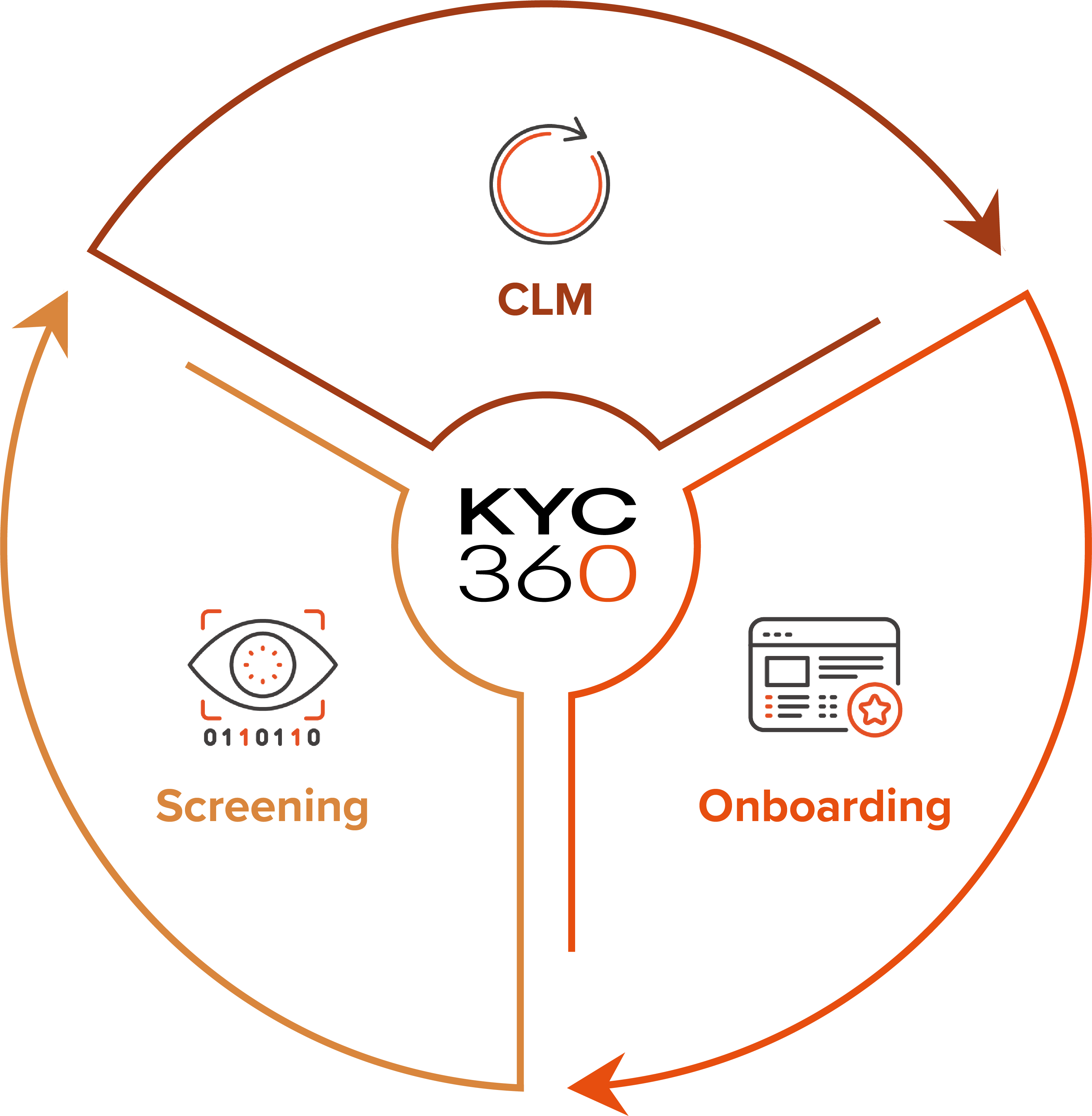
Consolidate your system stack and data vendor relationships with one platform to cover all Onboarding, Screening, Perpetual KYC (pKYC) and CLM tasks, with market-leading data sources pre-integrated under a single license agreement. Live risk scoring and automated data collection enables a shift from periodic to event-driven review, while providing a single actionable picture of real-time risk with all documents and data in one place.