KYC Remediation: A Growing Priority for Banks
KYC remediation is the process of reviewing, updating and validating customer data to ensure it meets current regulatory standards and accurately reflects each client's risk profile. For many banks, remediation can become less of a one-off project and more of a recurring operational reality.
Enforcement actions from the FCA, FinCEN and other global regulators have made clear that weak AML/KYC controls carry serious financial and reputational consequences. TD Bank's $3.1 billion AML fine in 2024 and recent UK enforcement actions against Nationwide, Monzo and Starling serve as a pointed reminder that poor controls and slow remediation have real consequences.
Alongside enforcement, regulatory expectations around data quality and ongoing due diligence continue to rise. Banks that treat remediation as a periodic fire drill, rather than a structured programme, risk accumulating backlogs that make a future project more costly and more disruptive.
This article sets out the key steps for planning and running a successful KYC remediation project, from initial scoping through to the controls that prevent the cycle from repeating.
Common Triggers for a KYC Remediation Project
The trigger for a remediation project tends to shape its scope, urgency and governance requirements. The most common causes are:
Regulatory or policy changes
As regulations evolve, existing KYC records can quickly fall short. A customer file that was fully compliant two years ago may no longer satisfy current standards around beneficial ownership, source of funds or enhanced due diligence.
Audit findings or regulatory reviews
Gaps in ongoing monitoring or inconsistent application of enhanced due diligence are among the most common findings from regulatory reviews and internal audits. When gaps are identified, regulators frequently mandate remediation within a defined deadline.
Data quality or completeness issues
Incomplete KYC files, data scattered across disparate systems, or records captured to a standard that no longer reflects the institution's risk appetite can lead to a customer base where significant portions of data cannot be relied upon.
M&A, system migrations or legacy backlogs
Mergers and acquisitions, particularly cross-border deals, introduce inherited KYC records built to different standards and regulatory frameworks. In correspondent banking structures this complexity compounds further. Each counterpart may have a different risk appetite, inconsistent data-gathering processes, and legacy backlogs that must be resolved before relationships can be maintained or expanded. Post-acquisition remediation is frequently the most resource-intensive variant of the exercise.
Remediation projects can differ significantly in scope and resourcing, so it is important to be clear from the outset about which type of exercise is involved:
• Business-as-usual KYC refresh - Routine updates to records that have passed their scheduled review date.
• Targeted remediation - A focused exercise addressing a specific subset of customers, product line or jurisdictional gap.
• Full-scale remediation programme - The most demanding type, involving most or all customer data across the book. Usually driven by a regulatory mandate or a significant acquisition.
Running a Successful KYC Remediation Project
1. Scope, risk and governance
Before a single customer file is reviewed, the right foundation needs to be in place. Segment the customer population by risk level. Those requiring enhanced due diligence should typically be prioritised ahead of lower-risk clients. A risk-based approach is a core regulatory expectation and, done well, it significantly reduces wasted effort across the programme. Jurisdictional factors must also be considered in client prioritisation. Requirements can vary considerably across markets, and clients in more stringent jurisdictions, or those where non-documentary validation is not an option, need to be identified and planned for early rather than discovered mid-project. Governance structure is also key. Ambiguity over who approves risk re-ratings, handles escalations or owns specific customer segments can lead to delays. Roles, responsibilities, SLAs and reporting lines should be clarified before the project begins.
2. Data assessment and gap analysis
A clear picture of existing data should be established before any outreach starts. That means reviewing customer records to identify what is missing, outdated or inconsistent, across every system that holds relevant information. Many banks hold KYC data in formats ranging from structured CRM records to legacy spreadsheets and PDFs. The current state of that data determines both the scale of outreach required and the approach to it. The remediation scope should be aligned with regulatory expectations at this stage.
3. Customer outreach and information collection
Outreach during remediation is more challenging than in initial onboarding. Clients who already have a relationship with a bank are often reluctant to provide information again, and response rates reflect this, typically ranging from 20 to 60 percent. Reducing friction should be the guiding principle. Only the information that is required should be requested, and it should only be requested once. Poorly explained outreach, repeated requests for the same data, or communications that look like phishing are all avoidable mistakes that damage engagement. A well-designed communications strategy, using the right channel for each client segment and following a clear escalation cadence from gentle reminder to urgent notice, consistently delivers better response rates. Forms that are unclear or poorly structured generate incomplete submissions, which means additional outreach cycles and additional cost.
4. Review, verify and reassess risk
Once responses come in, a structured review process is needed to assess whether the information meets the required standard. Client bases are rarely uniform. Different jurisdictions, entity types and risk categories can require different documentation, and a single review framework will not fit every case. As responses are verified, customer profiles should be updated, risk ratings reassessed and all outcomes recorded. Re-screening against sanctions lists, PEP databases and adverse media should form part of this step.
5. Audit trails and reporting
Ticking a box is not enough. Regulators want to see how and why decisions were made, not just that remediation took place. A defensible audit trail covering data collection, risk rating decisions and escalations is essential throughout. Regular reporting against defined KPIs keeps the project on track, gives leadership the visibility to make resourcing calls, and, for projects running under a regulatory mandate, provides the evidence needed to demonstrate progress at short notice.
Download the Definitive Guide to Remediation
How Technology Enables Scalable Remediation
Manual remediation does not scale. For institutions managing tens or hundreds of thousands of records, a process built on spreadsheets, siloed systems and manual data rekeying creates both cost and risk. Analysts end up spending the bulk of their time on administrative tasks rather than risk judgements. Data gets collected multiple times across teams with no single source of truth.
RegTech platforms can address this at scale. Data orchestration centralises information and improves accuracy across systems. Workflow management reduces manual error and keeps processes consistent. Automated KYC standardises data collection and risk assessment. Where non-documentary validation is applicable, it can validate tens of thousands of clients in a matter of hours, without any direct contact, dramatically shortening timelines for eligible clients.
The KYC360 platform is built for exactly this kind of work, combining automation with the operational support needed to run complex remediation programmes efficiently. We work with a network of trusted partners who bring deep industry knowledge and scalable resources where needed.
Find out more about our Remediation solution, and see how we helped a global bank remediate over 150,000 customers in three months.
Turning KYC Remediation into your Long-Term Compliance Strength
Banks that complete a remediation project and move on without changing their underlying processes will find themselves back in the same position. Breaking that cycle requires embedding the lessons into how the institution operates every day.
That means integrating ongoing monitoring into business-as-usual, establishing defined periodic refresh cycles, and putting data governance controls in place that keep customer risk current. An event-driven review model, where changes in a client's profile or external risk indicators automatically prompt action, is more precise and more efficient than calendar-based bulk exercises. Learn more about how KYC360 CLM enables a dynamic approach to risk oversight across the entire customer lifecycle.
A well-run remediation project can be seen as an opportunity. Getting customer data right produces a cleaner, more reliable picture of risk across the book, supporting sharper decisions in transaction monitoring, smoother onboarding, and less disruptive customer interactions going forward.
Remediation programmes are expensive and disruptive for a reason. The underlying processes were not built to prevent the problem from developing. Investing in the right people, processes and technology to sustain KYC data quality on an ongoing basis should not be seen as a prohibitive cost. It is an effective way to avoid the larger costs that comes with repeated large-scale programmes or significant regulatory fines.
The goal is not just a successful remediation project. It is building an AML programme where large-scale, reactive exercises become the exception rather than the rule. Get in touch with KYC360 today to discuss how we can support complex remediation and efficient risk management across the customer lifecycle.

The KYC360 platform is an end-to-end solution offering slicker business processes with a streamlined, automated approach to Know Your Customer (KYC) compliance. This enables our customers to outperform commercially through operational efficiency gains whilst delivering improved customer experience and KYC data quality.
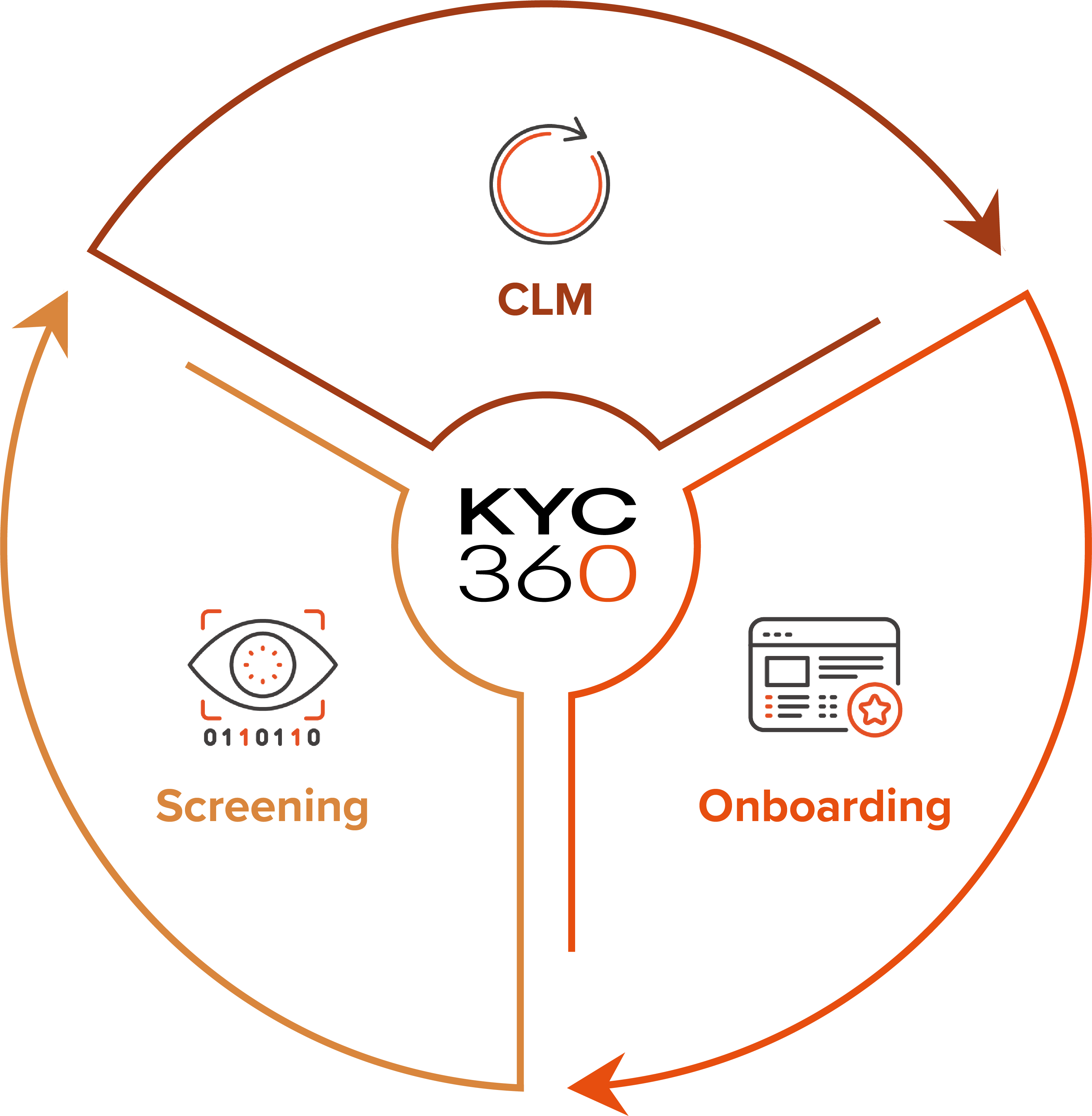
Consolidate your system stack and data vendor relationships with one platform to cover all Onboarding, Screening, Perpetual KYC (pKYC) and CLM tasks, with market-leading data sources pre-integrated under a single license agreement. Live risk scoring and automated data collection enables a shift from periodic to event-driven review, while providing a single actionable picture of real-time risk with all documents and data in one place.