The Growing Challenge of KYC Gaps in Banking
KYC gaps are the missing, outdated or inconsistent customer records that accumulate across a bank’s portfolio over time. The root causes tend to be legacy onboarding processes that captured less data than current rules require, regulatory change that shifts what “adequate” looks like, mergers that fold incompatible data sets together, and governance weaknesses that let quality drift unnoticed.
At scale, the problem compounds. A retail bank with millions of accounts may carry hundreds of thousands of files that no longer meet supervisory expectations on customer due diligence, risk assessment or ongoing monitoring. The FCA’s 2026 review of CDD controls flagged undefined review cycles and inconsistent periodic reviews as common weaknesses, while FATF guidance has long made clear that ongoing monitoring is a key part of CDD, not an optional extra. For more on how legacy files specifically drive remediation work, see our blog on KYC remediation campaigns for legacy customer files.
How KYC Gaps Impact Compliance, Risk, and Operational Efficiency
Unresolved KYC gaps cause harm on several fronts at once. Regulatory exposure is the most visible. The FCA fined Nationwide Building Society £44 million in December 2025 for inadequate AML systems and controls between 2016 and 2021, including ineffective due diligence and risk assessments for personal current account customers. By mid-2020, the regulator found, Nationwide had identified only around 2,000 high-risk customers out of more than 18 million. Monzo’s £21 million fine reflected similar themes: onboarding and customer risk assessment controls that did not scale with the customer base. Without complete customer information, risk profiles are inaccurate and monitoring rules cannot calibrate properly. The Nationwide case included a £27.3 million Covid furlough fraud, with £26 million deposited across just eight days, that went undetected.
Gaps create operational drag. This leads to duplicated work across systems, conflicting records, lengthy backlogs, and customers being asked for the same documents more than once. For more on the connection between CDD and remediation, see our guide on the future of customer due diligence.
Why Manual Remediation Processes Are Holding Banks Back
Manual remediation still dominates at many banks, despite well-understood limitations. The reliance on spreadsheets, email threads and case-by-case analyst review creates predictable problems. Error rates climb as files move between teams, often without a consistent audit trail of who made which decision and why. Scaling becomes expensive. Clearing a backlog of thousands or tens of thousands of files in twelve months requires significant analyst capacity, which extends timelines and inflates costs. Decisions vary between analysts, particularly on edge cases, which complicates both internal QA and external audit.
The deeper issue is that manual remediation tends to address the symptom rather than the cause. Once the project ends, the fragmented data architecture and reactive review cadence usually remain in place, so the same gaps re-emerge within a few years. At scale, this is not a sustainable operating model.
How Automated Remediation Solutions for Banks Close KYC Gaps at Scale
Automated remediation solutions for banks combine data orchestration, workflow automation, risk-based prioritisation and integrated customer outreach in a single platform.
Automation absorbs the work that consumes most analyst time, which is pulling and cross-referencing data from internal systems and external sources, flagging missing or outdated information, routing cases by risk score, and creating a consistent record of every action taken. Decisions follow defined rules rather than individual judgement on each file, which improves consistency across teams and produces the type of audit trail regulators expect to see. Risk-based logic ensures the highest-risk customers move first, with depth of review calibrated to the risk presented. Workflow automation removes the bottleneck of analyst chase-up by structuring outreach and document collection through digital channels. Dashboards give compliance leaders visibility into where each cohort stands in real time, rather than waiting for monthly status updates.
This creates operational efficiency without proportional headcount increases. Banks using KYC remediation software typically clear backlogs faster, with fewer rework cycles, and inherit the controls needed to keep new gaps from forming once the initial programme ends. However, technology alone does not fix poor process design. A weak risk model, unclear data ownership, or inadequate resources will produce the same problems whether the workflow runs in a spreadsheet or in software. Automation accelerates the process it sits on top of.
Moving Towards a Proactive Approach to KYC Remediation
Traditional remediation is reactive. An audit finding, regulatory letter or supervisory review triggers a campaign that clears one cohort of files, and the cycle repeats some years later. Automation makes a different operating model practical.
Continuous monitoring through Customer Lifecycle Management solutions embeds reviews into business-as-usual. A sanctions hit, change of beneficial ownership, expired document or unusual transaction generates an event-driven review, while periodic reviews are scheduled at a frequency calibrated to customer risk. Records can be validated against external data sources as customers change rather than at the next quarterly cycle.
The shift is from periodic clearance to ongoing maintenance. Done properly, it ensures that future remediation projects are smaller, more frequent, less disruptive, and more closely aligned with how customer data actually changes over time. That reduces the scope of future projects and makes audit findings less likely. For a structured view of how to plan and deliver remediation activity, see our blueprint for a successful KYC remediation project.
Building a Scalable, Future-Proof KYC Remediation Strategy
A strategy that holds up across regulatory cycles depends on automation integrated into the wider AML framework, remediation aligned to a risk-based approach, a continuous mindset in place of periodic project thinking, the right combination of technology and process design, and clear governance with named owners and escalation paths.
Human judgement should not be removed from compliance. However, that judgement should be focused on the files where it adds value, while taking the manual handling that drives errors and inconsistency out of the workflow.
Automated remediation solutions for banks provide a scalable, consistent and audit-ready approach to closing KYC gaps without overwhelming compliance teams. Explore how leading financial institutions are modernising their remediation strategies and reducing compliance risk through automation with KYC360.

The KYC360 platform is an end-to-end solution offering slicker business processes with a streamlined, automated approach to Know Your Customer (KYC) compliance. This enables our customers to outperform commercially through operational efficiency gains whilst delivering improved customer experience and KYC data quality.
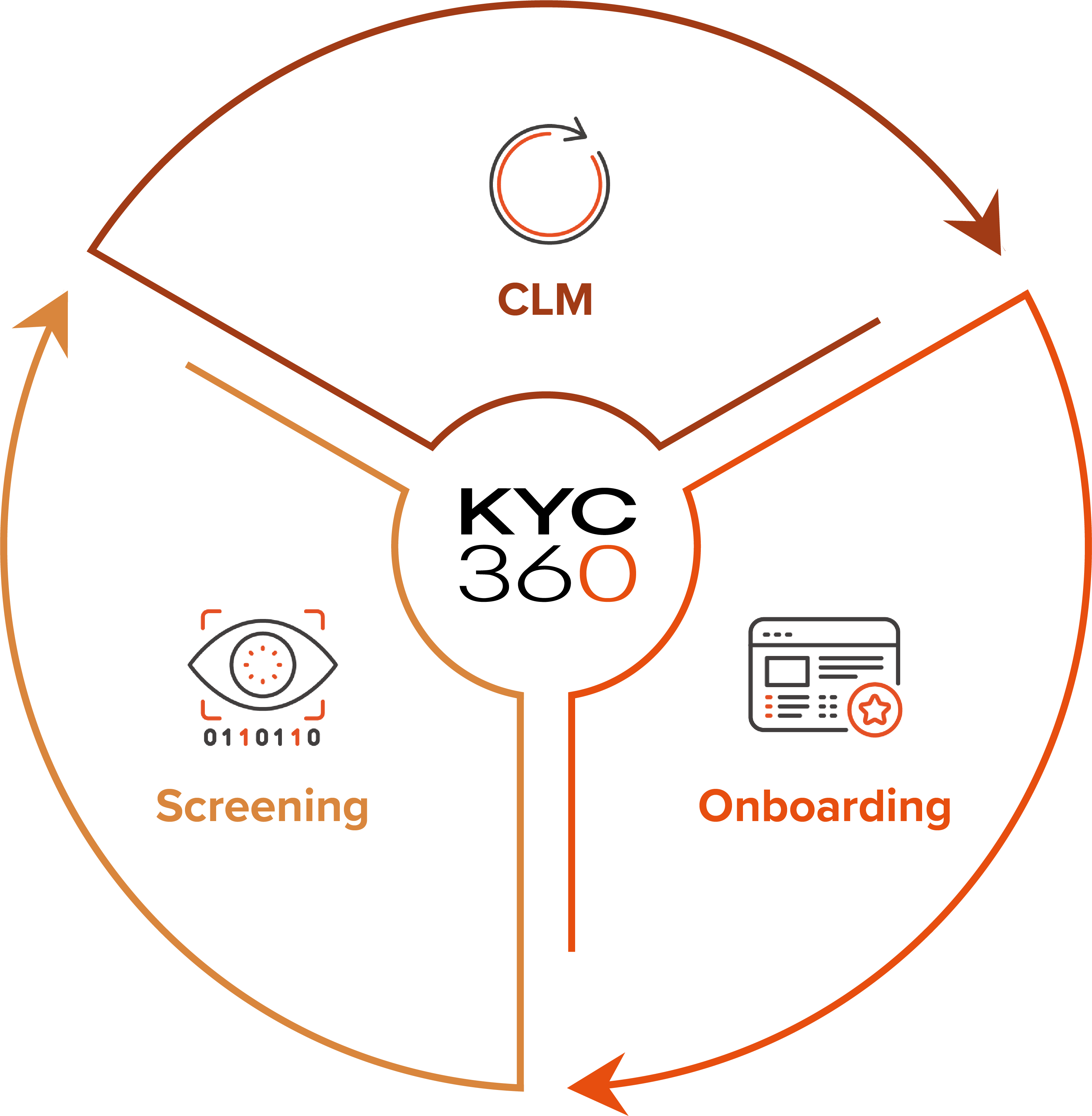
Consolidate your system stack and data vendor relationships with one platform to cover all Onboarding, Screening, Perpetual KYC (pKYC) and CLM tasks, with market-leading data sources pre-integrated under a single license agreement. Live risk scoring and automated data collection enables a shift from periodic to event-driven review, while providing a single actionable picture of real-time risk with all documents and data in one place.