PEP Screening for Wealth Managers: Handling the Concentration of Exposure in Private Client Books
Reviewed by: Tom Devlin, Managing Director at KYC360
Last Updated 29/09/26
Private client books can bring together PEP exposure, complex ownership structures and cross-border wealth within advisory relationships. Senior public officials may be connected to family members, close associates and structures that make the screening picture more complex than a simple name match. Under UK rules, domestic PEPs start from a lower-risk position than non-domestic PEPs where no enhanced risk factors are present, but EDD still applies. For wealth managers, the challenge is identification, proportionate scrutiny and keeping that judgement current.
Why PEP Exposure Concentrates in Wealth Management
Wealth itself does not indicate PEP risk. The challenge is that private wealth relationships can involve family networks, layered ownership and cross-border structures. Where a PEP is involved, firms may need to look beyond the named client to relevant beneficial owners, family members and close associates.
That makes proportionality particularly important. PEP status is a financial crime risk factor, not evidence of wrongdoing. FATF describes the additional measures applied to PEPs as preventive, while the FCA’s current guidance requires firms to assess the actual risk presented by each relationship.
For wealth managers, the task is therefore to identify PEP exposure accurately without treating every politically connected client as presenting the same level of risk.
The Current UK PEP Rules After FG25/3
The legal starting point for domestic PEPs changed on 10 January 2024. Under Regulation 35 of the Money Laundering Regulations 2017, the starting point is that a domestic PEP, or their family member or known close associate, presents a lower level of risk than a non-domestic PEP. Where no enhanced risk factors are present, the extent of EDD should also be lower.
The FCA’s FG25/3 guidance makes clear that this does not remove EDD. Firms are required to obtain senior management approval to establish or continue the relationship and must take adequate measures to establish source of wealth and source of funds, and conduct enhanced ongoing monitoring.
A PEP must continue to be treated as a PEP for at least 12 months after leaving office, with longer treatment where the assessed risk justifies it. Family members should return to ordinary CDD when the PEP leaves office unless other risk factors justify additional measures. For more on changing PEP status, see our blog once a PEP always a PEP? Proportionality also needs to be evidenced. Firms should record why a PEP relationship has been assessed as lower or higher risk, what level of EDD follows from that assessment and who approved the decision. For lower-risk relationships, FCA guidance allows less intrusive checks and approval at a lower level of seniority, provided the decision-maker has sufficient authority.
What Makes One PEP Relationship Higher Risk Than Another
PEP status should trigger a risk assessment, not determine the outcome of it. The FCA expects firms to consider the public function held, the jurisdiction in which it is exercised, the nature of the client relationship and whether the product could be misused to launder the proceeds of corruption.
Personal circumstances matter too. Wealth or a lifestyle inconsistent with known legitimate sources, credible allegations of financial misconduct, or influence over major public procurement or government licences can all point towards higher risk. Lower-risk products, political exposure in jurisdictions with strong institutions and lower corruption risk, or roles without executive decision-making responsibility may point in the other direction.
Screening for PEP status: Getting Identification Right
PEP screening needs to determine whether a client or beneficial owner is a PEP, a family member of a PEP or a known close associate. In the FCA’s 2024 treatment of PEPs review, Seven of the 15 firms examined in detail used definitions of PEPs and/or relatives and close associates that were wider than the FCA expected. The FCA also stresses that firms using commercial databases need to understand how they are populated and check that people flagged by the system actually meet the relevant definition.
In wealth management, PEP exposure can also arise through a company, trust or other legal arrangement rather than through the named client alone. Firms therefore need to understand beneficial ownership and the relationships around the structure. A PEP may be a beneficial owner, while the definition of a known close associate can also capture joint beneficial ownership or an arrangement established for a PEP’s benefit. A legal entity should not, however, automatically be treated as a PEP simply because a PEP is one of its beneficial owners.
That makes the quality and configurability of underlying data important. KYC360 can integrate Dow Jones, LSEG World-Check and LexisNexis data, allowing wealth management firms to choose the source appropriate to their screening requirements. The 3D risk-based approach also allows screening parameters to reflect client risk rather than treating every match identically.
For wider guidance on identifying and managing politically exposed persons, see our article on PEP screening. KYC360’s PEP screening solution supports sanctions, PEP, watchlist and adverse media screening within a single workflow.
Source of Wealth: The Wealth-Sector Pressure Point
For PEP relationships, understanding how a client accumulated their wealth is a core part of EDD. Firms must take adequate measures to establish both source of wealth and source of funds, with the depth of investigation proportionate to risk. Source of wealth explains how the client accumulated their overall wealth, while source of funds explains the origin of the specific money or assets involved in the relationship or transaction. The Wolfsberg Group’s Source of Wealth and Source of Funds guidance treats both as important elements of risk assessment for relevant private banking and wealth management clients.
A declaration alone may not be enough where risk is elevated. Firms may need independent evidence to assess whether the client’s explanation is plausible. Adverse media monitoring can surface information that calls a stated source of wealth into question. KYC360 also supports targeted public-domain source-of-wealth research, helping analysts locate information relevant to how wealth may have been accumulated and identify areas that warrant further investigation.
Ongoing Monitoring Across a Long-Term Relationship
PEP risk is not static. A private client may take public office after onboarding, leave office during a long-standing relationship, acquire new business interests or become connected to a PEP through a relevant association. Screening therefore needs to operate beyond account opening. Enhanced ongoing monitoring, periodic re-screening and trigger-based review help wealth managers keep PEP classification and risk assessments current. Live adverse media can also surface material developments between formal reviews.
The objective is to apply greater attention where the risk requires it while avoiding disproportionate checks on lower-risk relationships. KYC360’s risk-based screening and live adverse media capabilities support that differentiated approach across the client lifecycle.
KYC360’s approach to client lifecycle management has been recognised by Chartis Research, which named it a 2026 Category Leader for CLM and a Gold ‘Market Disruptor’.
Conclusion
PEP relationships rarely stay static. Public roles change, ownership structures evolve and new information can alter the risk around a long-standing client relationship. Accurate screening therefore needs to be matched by an assessment that remains current over time. That means combining reliable screening data with proportionate EDD, source-of-wealth checks and ongoing monitoring. The aim is to apply deeper scrutiny where the evidence supports it, without placing unnecessary requirements on lower-risk relationships.
Request a demo to see how the KYC360 PEP Screening Platform can support efficient screening at scale.

The KYC360 platform is an end-to-end solution offering slicker business processes with a streamlined, automated approach to Know Your Customer (KYC) compliance. This enables our customers to outperform commercially through operational efficiency gains whilst delivering improved customer experience and KYC data quality.
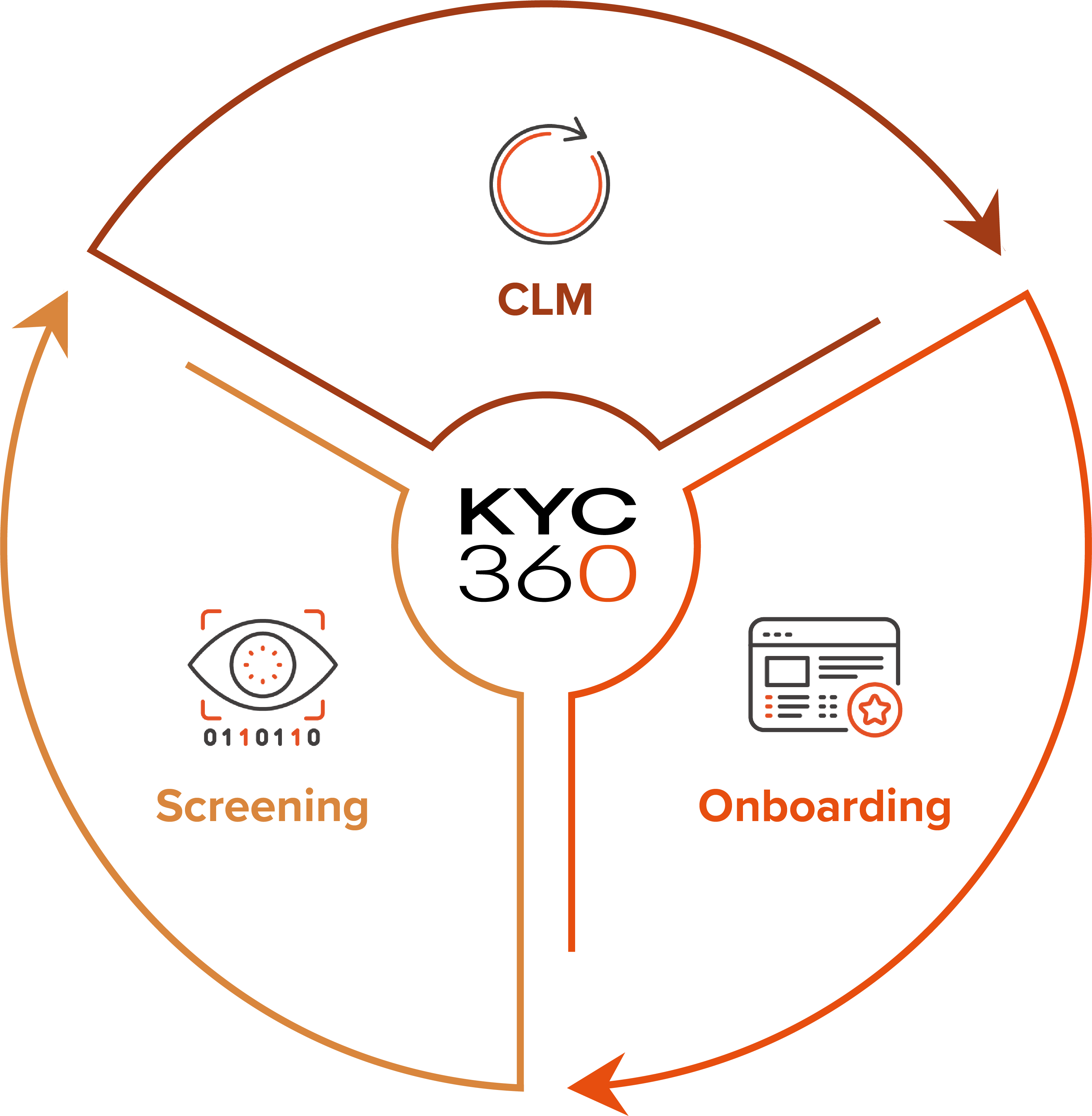
Consolidate your system stack and data vendor relationships with one platform to cover all Onboarding, Screening, Perpetual KYC (pKYC) and CLM tasks, with market-leading data sources pre-integrated under a single license agreement. Live risk scoring and automated data collection enables a shift from periodic to event-driven review, while providing a single actionable picture of real-time risk with all documents and data in one place.