The Priorities Shaping Financial Crime Compliance: Insights from Compliance Leaders
Financial crime teams are being asked to detect more, act faster and make decisions they can defend. Yet many investigators still spend too much of their time clearing alerts that lead nowhere. KYC360 attended the 1LoD Financial Crime Leaders’ Network roundtable in June 2026, joining leaders for a discussion centred around key challenges. The notable takeaway was that better technology alone won’t solve challenges when alerts are noisy, data is fragmented and processes are rigid.
False Positives are Draining Investigative Capacity
Participants described false positives as one of the biggest sources of inefficiency across sanctions screening and transaction monitoring. Some reported false positive rates of 85–95% in transaction monitoring operations, leaving investigators with large volumes of low-value cases and less time for meaningful analysis. That makes improving alert quality an immediate priority. Better matching, richer context and more effective prioritisation can help direct attention towards cases that genuinely merit investigation.
AI Can Help If the Foundations are Sound
Leaders also shared examples of AI and analytical models being used to prioritise alerts, support plausibility checks and reduce manual work. One organisation reported cutting onboarding turnaround from several days to less than a day after introducing AI-supported reviews.
But the discussions were clear that automation cannot compensate for poor inputs or needlessly complicated processes. Incomplete customer data, fragmented systems and years of workarounds can undermine screening and monitoring before a model is even applied. Participants argued for simplifying processes and clarifying ownership before automating them at scale.
AI also needs evidence and oversight. Firms need to test model performance, understand what data drives decisions, and show how outcomes are monitored. That matters especially where MLROs and other leaders remain responsible for decisions.
Review Models Must Respond to Continuous Risk Changes
A fixed review calendar can leave a gap between a material change in a customer’s circumstances and the next scheduled review. Participants saw potential in perpetual KYC and event-driven monitoring: reassessing risk when relevant information changes, rather than relying only on one-, three- or five-year cycles.
That does not mean every customer needs constant outreach or that periodic controls disappear. It means firms need a reliable way to identify changes, assess whether they matter under policy, and route the right cases for action. A connected customer lifecycle management approach can bring KYC and KYB data, screening, risk assessment, workflows and decision records together across the relationship.
The Foundations for More Effective Financial Crime Controls
Taken together, the discussion points to a practical set of priorities: improving the quality data, simpler processes, well-governed AI, clear accountability and skilled people. As routine alert handling becomes more automated, teams will need to put more emphasis on judgement, exception management and oversight.
For a deeper look at what leaders shared and the trade-offs behind these priorities, download the full report.
For those considering how KYC can move from scheduled reviews to a more responsive, risk-led model, Tom Devlin, Managing Director at KYC360, will join the panel “What is Next for KYC?” at the 1LoD Financial Crime Summit London on 12 November 2026, 11:15–11:55. The discussion will cover perpetual KYC, continuous risk management and data ownership.

The KYC360 platform is an end-to-end solution offering slicker business processes with a streamlined, automated approach to Know Your Customer (KYC) compliance. This enables our customers to outperform commercially through operational efficiency gains whilst delivering improved customer experience and KYC data quality.
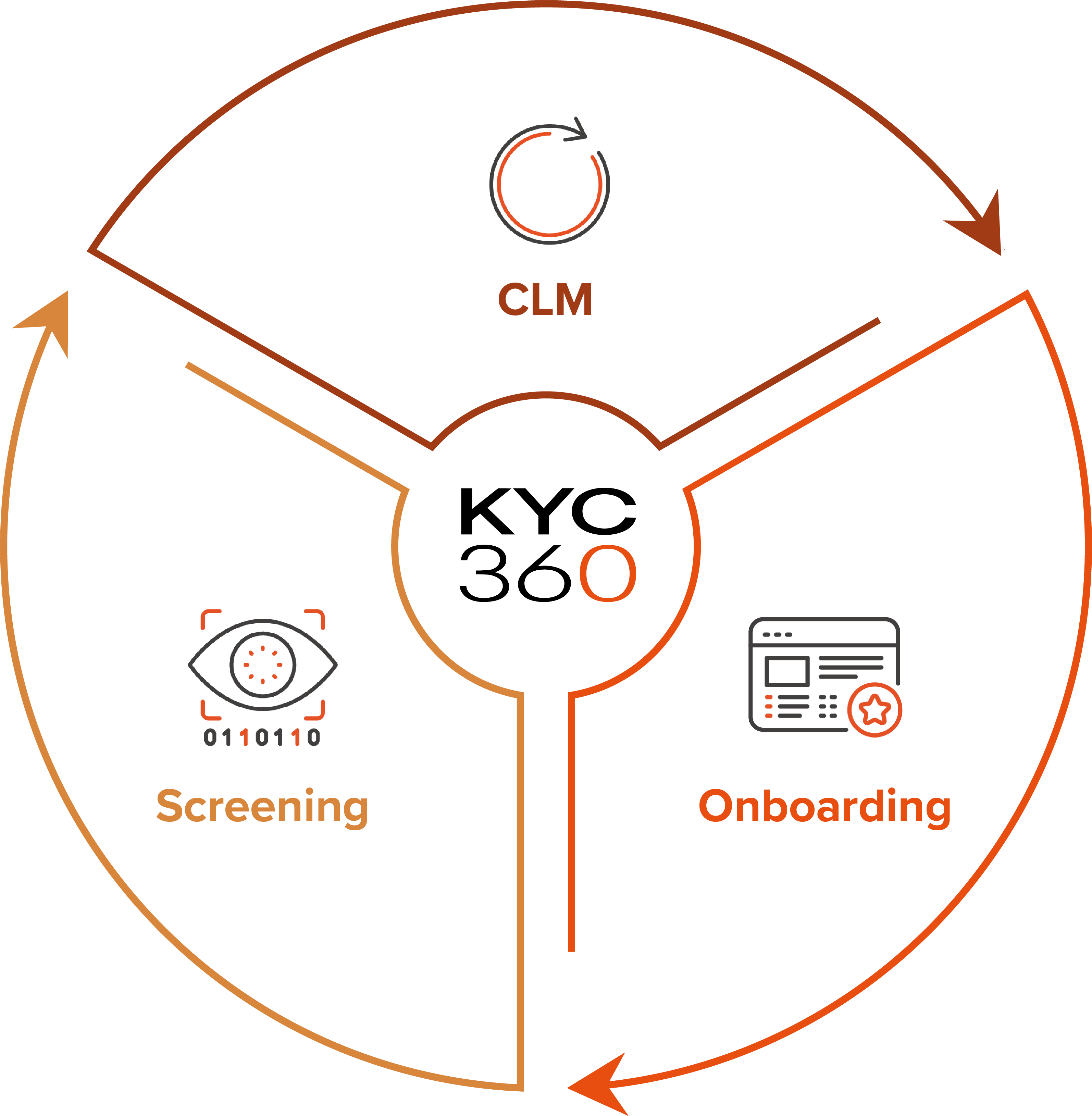
Consolidate your system stack and data vendor relationships with one platform to cover all Onboarding, Screening, Perpetual KYC (pKYC) and CLM tasks, with market-leading data sources pre-integrated under a single license agreement. Live risk scoring and automated data collection enables a shift from periodic to event-driven review, while providing a single actionable picture of real-time risk with all documents and data in one place.