The AML & KYC Adverse Media Screening Process Explained Step by Step
Reviewed by: Tom Devlin, Managing Director at KYC360
Last Updated 24/11/26
An adverse media alert might begin with a customer’s name in a news story, court record or regulator notice. Whether it matters depends on who the report concerns, what it says and how reliable the source is. Adverse media screening, also referred to as adverse media monitoring or negative news screening, helps firms find and assess this information as part of KYC.
What is adverse media screening and what role does it play in KYC?
Sanctions and politically exposed person (PEP) checks generally compare customers with defined lists. Adverse media screening complements those checks by searching public information that may add context to a customer’s risk profile. The FATF Recommendations set international standards for countries’ AML/CFT systems. They do not establish a universal, standalone adverse media screening requirement. The Wolfsberg Group notes that FATF risk-based guidance refers to adverse media searches as one possible enhanced due diligence measure.
For UK firms within scope, the Money Laundering Regulations require ongoing monitoring of business relationships. This includes scrutiny of transactions and, where necessary, their source of funds, in light of the firm’s knowledge of the customer and their risk profile. The screening approach should reflect the firm’s risk assessment and the rules that apply to it.
The AML & KYC adverse media screening process step by step
Step 1 - Define who and what to screen
Set the scope before searching. Identify which customers, beneficial owners and connected parties are covered by the firm’s risk framework. Choose relevant crime categories and decide which stages of an event to include, from allegation and investigation through to charge and conviction.
Potential categories can include:
-
Money laundering
-
Terrorist financing
-
Bribery and corruption
-
Fraud and relevant financial crime
-
Organised crime
-
Drug trafficking
-
Human trafficking
-
Wildlife trafficking
-
Proliferation and proliferation financing
-
Tax evasion
The earlier the event stage, the more alerts a search is likely to return. Wolfsberg cautions that allegation-stage screening produces more alerts than conviction-stage screening, and those alerts may have less AML/CTF value. Broader coverage may surface earlier information, but calls for more careful review. The scope also determines whether a structured dataset is enough. Live adverse media (Live AVM) screening searches unstructured online sources, such as Google and Bing, for information that may not appear in structured adverse-media records. KYC360’s Live AVM screening module can be configured by search terms, country and date range. That wider search can surface broader reputational concerns.
Adverse media examples
|
Illustrative report |
Next steps |
|
Reporting on a money-laundering investigation |
Check the identity, the person’s role and the investigation’s status. |
|
Court or regulator coverage of alleged bribery, fraud or tax offences |
Verify the source, the customer’s involvement and the outcome. |
|
Reporting on trafficking or proliferation-financing risks |
Establish whether the report concerns the customer and is relevant to financial crime risk. |
Step 2 - Prepare and verify customer data
Before screening, check the customer information the search will rely on. For an individual, this may include their full name, aliases, date of birth, nationality and location. For an organisation, it may include legal and trading names, registration details, jurisdiction and beneficial ownership. Reliable identifiers help distinguish a customer from people or entities with similar names. No matching tool can make up for incomplete or inaccurate records. KYC360 supports both individual screening and screening customer groups, so checks can fit the onboarding or review process.
Step 3 - Screen against relevant adverse media sources
Search sources suited to the customer’s geography, language and risk. These may include reputable local and national reporting, court records, regulatory disclosures and penalty notices. Consider the source’s accuracy, completeness and timeliness; a longer source list does not automatically produce better screening. Live AVM can extend a search beyond structured data by querying configured search engines, including Google, Bing and Bing News. Search terms, country and date range can be tailored, and irrelevant URLs excluded. The results still need scrutiny. Search engines find material, but do not verify it.
Step 4 - Verify the match and filter false positives
A result may refer to someone with a similar name. Compare it with available identifiers, such as date of birth, location, employer and corporate relationships. A name match alone is not enough. Reviewers should record why a result was flagged or discounted. KYC360 AVM Screening supports individual and bulk actions, with categories and reasons recorded for the decision. Bulk discounting can save time when the same rationale genuinely applies to several results. It should not replace checking whether each result is relevant.
Step 5 - Assess credibility, relevance and materiality
A credible report can still be irrelevant to the customer, and a relevant allegation is not the same as a proven offence. Consider:
Credibility: Is the source reliable and independent? Is the report corroborated?
Relevance: Does the information concern financial crime risk, and what was the customer’s role?
Materiality: How serious and recent is the information, and what is its current status?
For EU financial institutions, the EBA’s ML/TF risk-factor guidelines identify adverse media as a factor relevant to customer reputation. They advise assessing the reliability of allegations, including the source’s quality and independence and how persistently the information has been reported.
Step 6 - Investigate, document and take action
If a result may be material, investigate further. Depending on the findings and applicable requirements, this could mean seeking more information, applying enhanced due diligence, reviewing source-of-funds or source-of-wealth information, updating the customer’s risk rating or escalating the case.
Keep the evidence and reasoning together: the source and date, the match assessment, the decision and any action taken. In its April 2026 review of customer due diligence controls, the FCA found that some firms failed to evidence or document enhanced due diligence for high-risk customers. KYC360’s reporting workflow can bring potential, flagged and discounted results, along with search history, into the review record.
Step 7 - Monitor for new adverse media
A point-in-time search only shows what was available when it ran. New reporting can emerge later, so firms should decide whether to screen at onboarding, during scheduled reviews, after a material change or between reviews. AVM Screening can run repeat searches at a configured frequency and retain results alongside other screening records. Set the cadence according to risk.
Adverse media screening guidelines and best practices
A consistent and proportionate process should include:
-
A clear scope and relevant risk categories
-
Customer information and sources suited to the customer’s geography and risk
-
Defined matching, review and escalation criteria
-
Recorded decisions and reasons
-
Regular checks of source coverage, alert handling and filtering
Where manual adverse media screening falls short
Manual searches can work for an individual enquiry, but become harder to repeat consistently across a large customer base or multiple languages. Search results can change over time, and search engines may rank the same information differently for different users. They are not databases designed to assess financial crime risk.
What should an adverse media screening tool do?
A screening tool should help teams find relevant information, distinguish genuine matches from false positives, record decisions and revisit customers when risk changes. It should make the work easier to follow without making the judgement on the firm’s behalf.
KYC360 combines structured screening data with optional Live AVM searches of wider online sources. Search criteria and repeat-search frequency can be configured, while review outcomes can be carried into reporting. KYC360 is recognised as a Noteworthy Solution in Celent’s “Know Your Customer Systems: Adverse Media Screening” report.
Contact us today to learn more about how KYC360 supports efficient adverse media screening workflows.

The KYC360 platform is an end-to-end solution offering slicker business processes with a streamlined, automated approach to Know Your Customer (KYC) compliance. This enables our customers to outperform commercially through operational efficiency gains whilst delivering improved customer experience and KYC data quality.
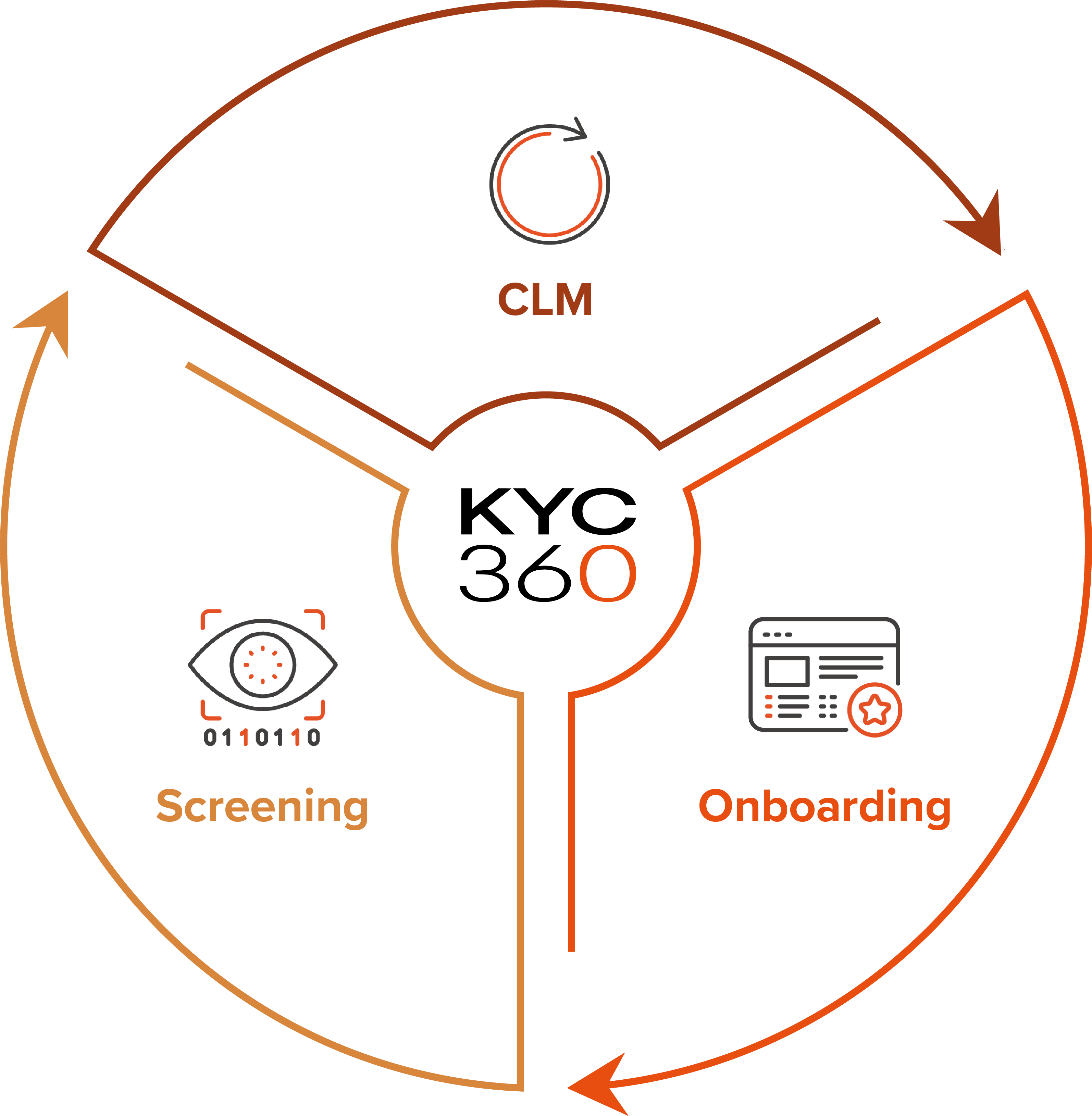
Consolidate your system stack and data vendor relationships with one platform to cover all Onboarding, Screening, Perpetual KYC (pKYC) and CLM tasks, with market-leading data sources pre-integrated under a single license agreement. Live risk scoring and automated data collection enables a shift from periodic to event-driven review, while providing a single actionable picture of real-time risk with all documents and data in one place.