KYC in Complex Relationships: Structures, Risk and Escalation
KYC360 recently held a session at the School of International Financial Services (SIFS) to explore one of the most persistent operational challenges in compliance, managing KYC across complex client relationships. The talk covered layered ownership structures, risk escalation triggers, and the systems firms are relying on to keep pace. During the session, attendees answered a series of live polls, which offer a useful window into the key challenges of compliance teams.
The Challenges of Managing Periodic Reviews Manually
Periodic reviews exist to keep client risk current. However, when managed manually, reviews can become a backlog rather than a safeguard. The core problem is that manual processes are inherently reactive. A review gets triggered because a date has passed, not because something has changed. By the time a team works through its caseload, some of the risk it is assessing is already out of date.
The operational burden compounds this. Analysts spend significant time tracking which clients are due for review, chasing documents across teams, and rekeying data that already exists somewhere in the organisation. None of that activity moves risk decisions forward.
KYC remediation is where the strain is most visible. Asking a client to provide information they have already submitted can impact on customer experience. When the same information gets requested multiple times because it is held in different systems or has not been transferred correctly, client frustration rises and response rates fall.
Consistent risk assessment is equally difficult to achieve at scale. Where judgement varies between analysts, or where different jurisdictions carry different regulatory requirements, the same client structure can produce different outcomes depending on who is doing the review and when.
The Challenges of Managing Complex Relationships
A complex structure is not simply a large client. It is a client whose onboarding requires understanding a web of connected parties, which can include holding companies, subsidiaries, nominees, special purpose vehicles, and individual beneficial owners, often spread across multiple jurisdictions. Each layer has to be examined and each relevant party has to be identified, verified, and risk-rated. Those individual ratings then need to feed into a single aggregated risk score for the relationship as a whole.
That process is difficult to do well even once. Maintaining it over time is harder. Ownership structures change. New beneficial owners emerge. Entities move jurisdictions. Each of those changes can alter the risk profile of the entire structure. The Panama Papers brought this challenge into sharp focus. They demonstrated how opaque structures, particularly those spanning offshore jurisdictions with limited transparency, can be used to obscure beneficial ownership.
Manual approaches to complex client management make effective oversight difficult. When information about different parts of a structure is collected one step at a time, the process slows, touchpoints multiply, and the risk of gaps increases. For more information, you can read our guide to Solving the Challenges of Onboarding Complex Structures.
How Firms are Managing KYC
The live polls during the SIFS session gave a clear picture of where the industry currently stands.
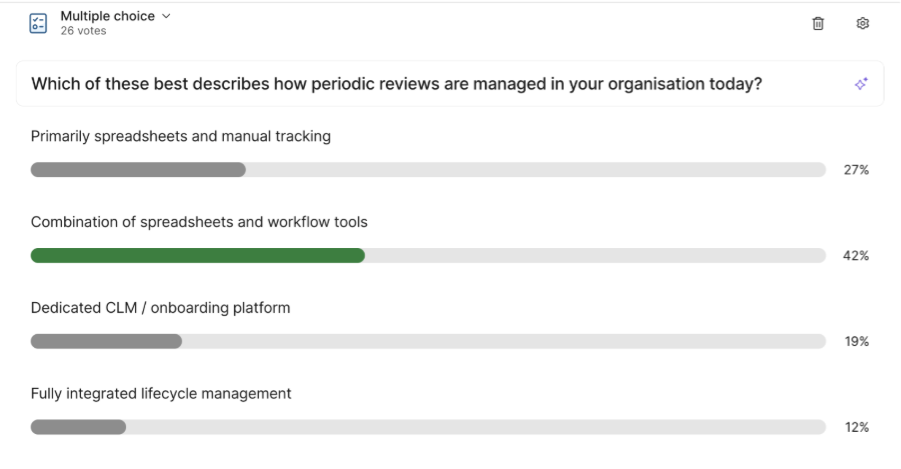
The majority of respondents manage periodic reviews using a combination of spreadsheets and workflow tools, with more than a quarter relying primarily on spreadsheets and manual tracking. Only a small minority have moved to a dedicated CLM or onboarding platform, and fewer have achieved fully integrated lifecycle management. This highlights how for most firms, periodic reviews are still a largely manual exercise.
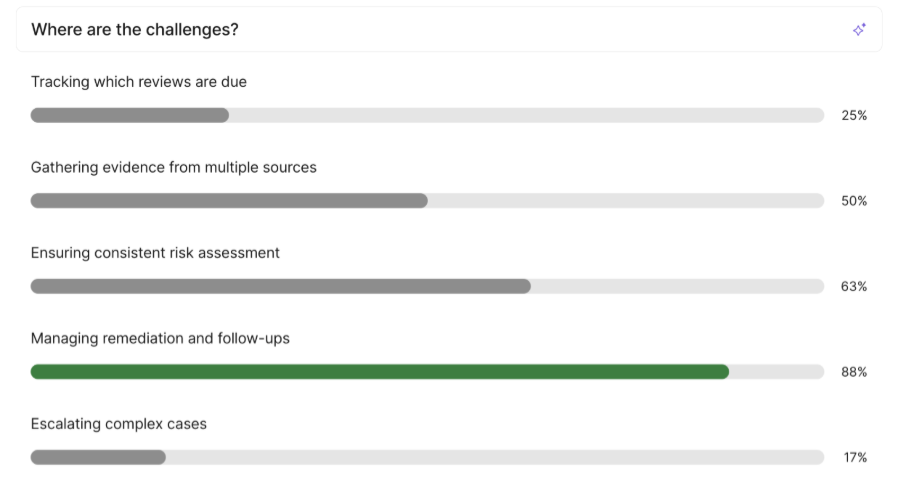
Managing remediation and follow-ups stands out as the single biggest pain point, with 88% of respondents identifying it. Ensuring consistent risk assessment follows at 63%, and gathering evidence from multiple sources at 50%. These three challenges are all symptoms of the same underlying problem, fragmented data and processes that cannot support the demands of ongoing client risk management.
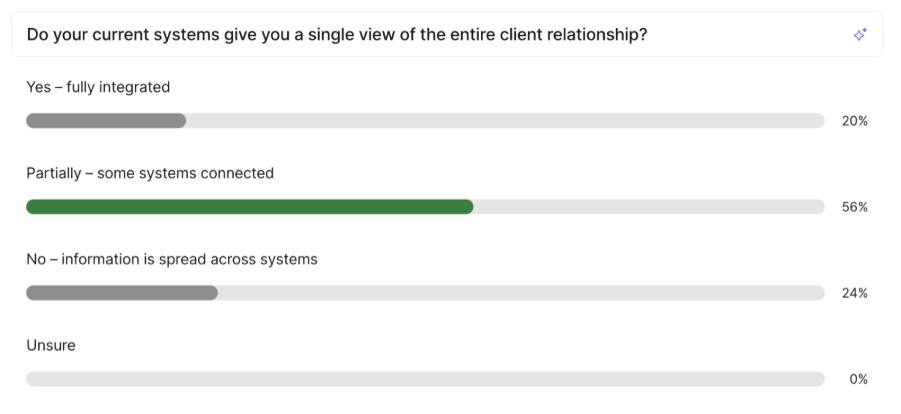
Only 20% of respondents have a fully integrated single view of the client relationship. The majority are working with partially connected systems, and nearly a quarter have information spread across entirely separate platforms. Without a unified view, risk cannot be assessed in real time. Teams are making decisions based on an incomplete picture.
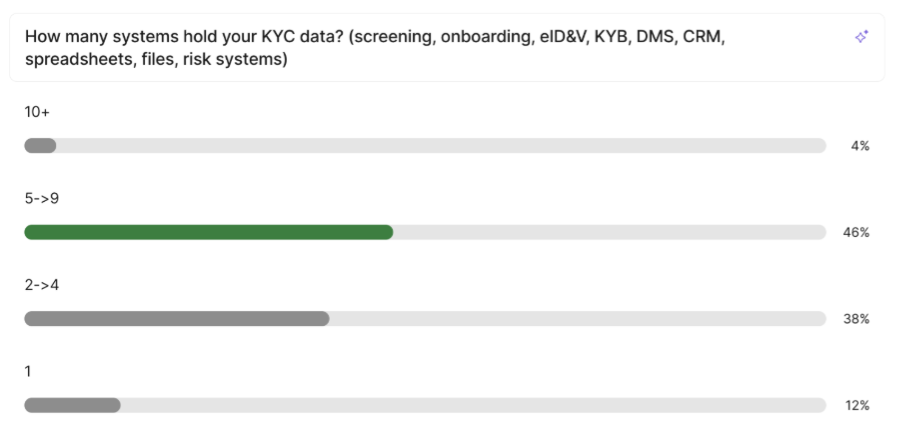
88% of respondents hold KYC data across two or more systems, with 46% managing it across five to nine. The result is constant manual effort to reconcile data across platforms, a high risk of compliance gaps, and less efficient workflows.
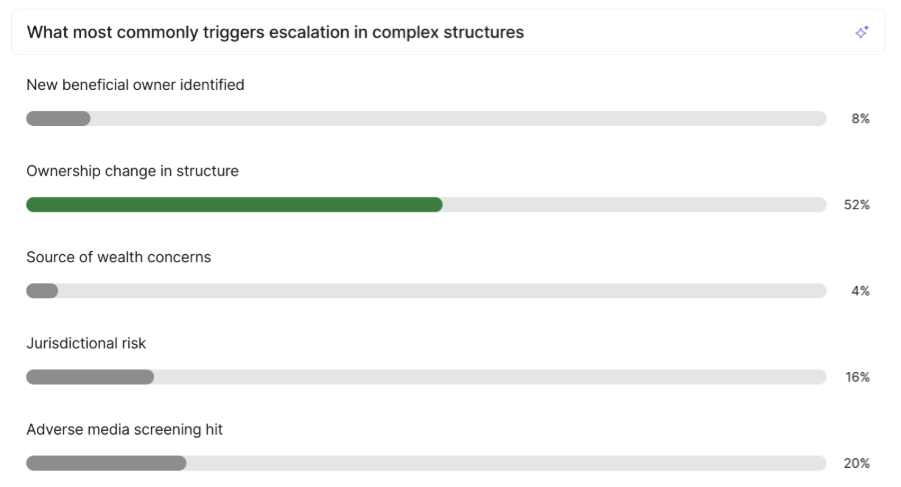
When it comes to escalation, ownership change in structure is the clear primary trigger, identified by 52% of respondents. Adverse media screening hits come second at 20%, followed by jurisdictional risk at 16%. What this highlights is that firms know what they are looking for. The challenge is being in a position to act on it quickly. When beneficial ownership changes happen within opaque structures and KYC data is spread across multiple systems, detecting and responding to that change is slow, manual work.
How KYC360 CLM Addresses these Challenges
The KYC360 Customer Lifecycle Management (CLM) solution is built to solve these challenges. Compliance teams have a single, always-current source of truth with documents, data, and risk decisions in one place. This gives teams a live dynamic view of each customer’s risk profile rather than a snapshot taken at the point of the last review.
The shift from periodic to event-driven review is central to how CLM works. Rather than waiting for a calendar date to trigger a review, CLM responds to real-time events such as expired documents, sanctions hits, adverse media, and ownership changes. Steps, responsibilities, and approvals are defined in advance, which ensures a consistent response.
Automated external data collection reduces the burden on both analysts and clients. Where information needs to be refreshed, CLM can generate a targeted data collection request directly, rather than requiring a full manual review cycle. Staff can auto-refresh or update data before a scheduled review, where it is feasible to do so, which means fewer unnecessary touchpoints with clients and faster resolution of cases.
Risk scoring is live and configurable. Multiple risk models can run simultaneously, covering AML, ABC, suitability, and operational risk, and the platform supports jurisdiction-specific collaboration with granular permission controls.
Advanced reporting gives compliance teams and leadership visibility across business lines and group level, covering risk distribution, KYC adequacy, and periodic review status. The result is a compliance operation that is faster, more consistent, and better equipped to act when client risk changes. Learn more about how KYC360 CLM can transform your approach to ongoing client risk management. by booking a demo today.

The KYC360 platform is an end-to-end solution offering slicker business processes with a streamlined, automated approach to Know Your Customer (KYC) compliance. This enables our customers to outperform commercially through operational efficiency gains whilst delivering improved customer experience and KYC data quality.
Consolidate your system stack and data vendor relationships with one platform to cover all Onboarding, Screening, Perpetual KYC (pKYC) and CLM tasks, with market-leading data sources pre-integrated under a single license agreement. Live risk scoring and automated data collection enables a shift from periodic to event-driven review, while providing a single actionable picture of real-time risk with all documents and data in one place.